
Spotify
Adding a feature
History
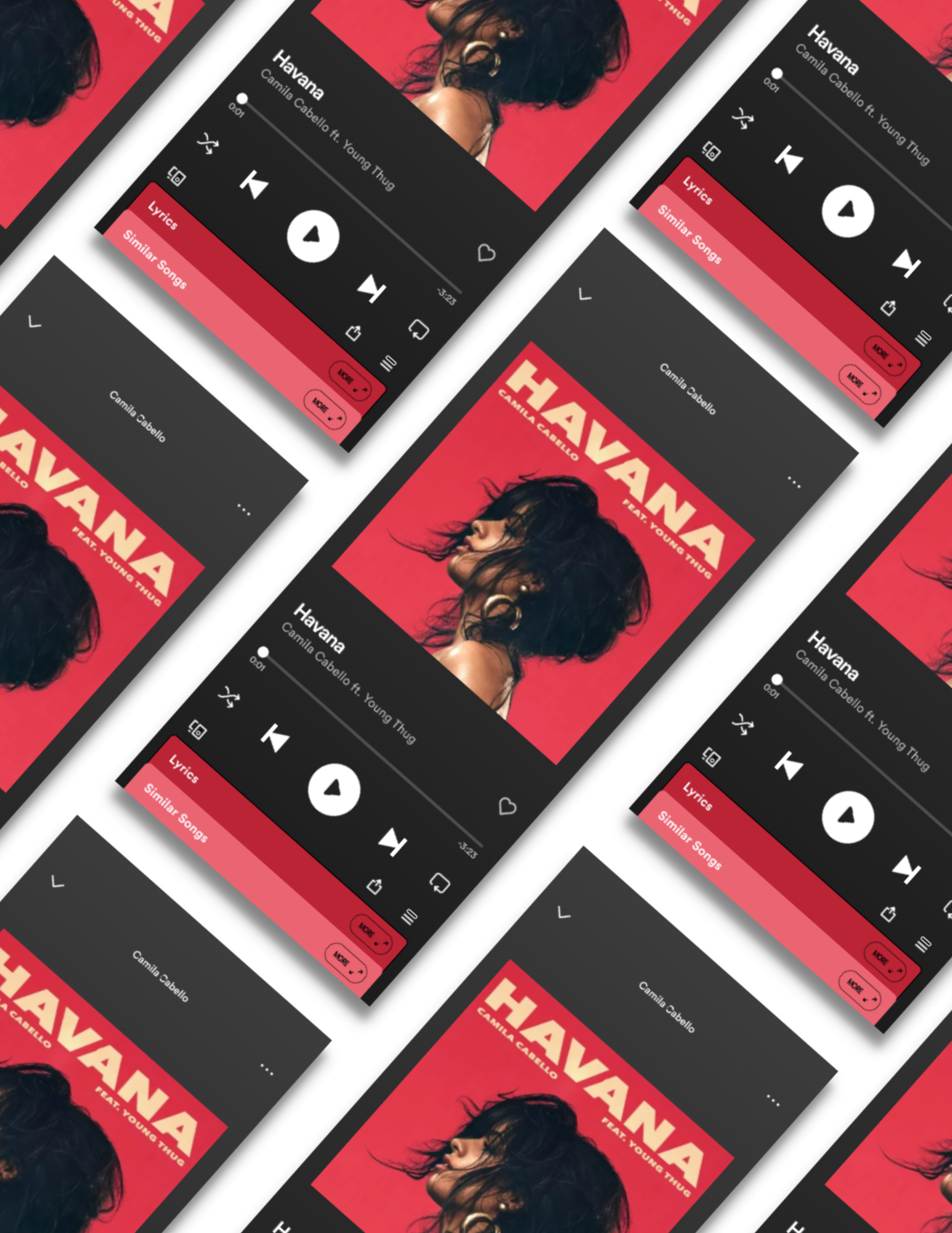
Spotify has become one of the top apps when it comes to streaming music. It was founded in 2006 by Daniel Ek and Martin Lorentzon in Stockholm, Sweden as a way to deal with the problem of music piracy. Spotify kept its black-and-green identity consistent through today, though it has been complemented by a color identity refresh in 2015. Their mission statement is: Our mission is to unlock the potential of human creativity - by giving a million creative artists the opportunity to live off their art and billions of fans the opportunity to enjoy and be inspired by it. Although it started off for music, Spotify has also branched into the world of podcasts.
My role: UX Design
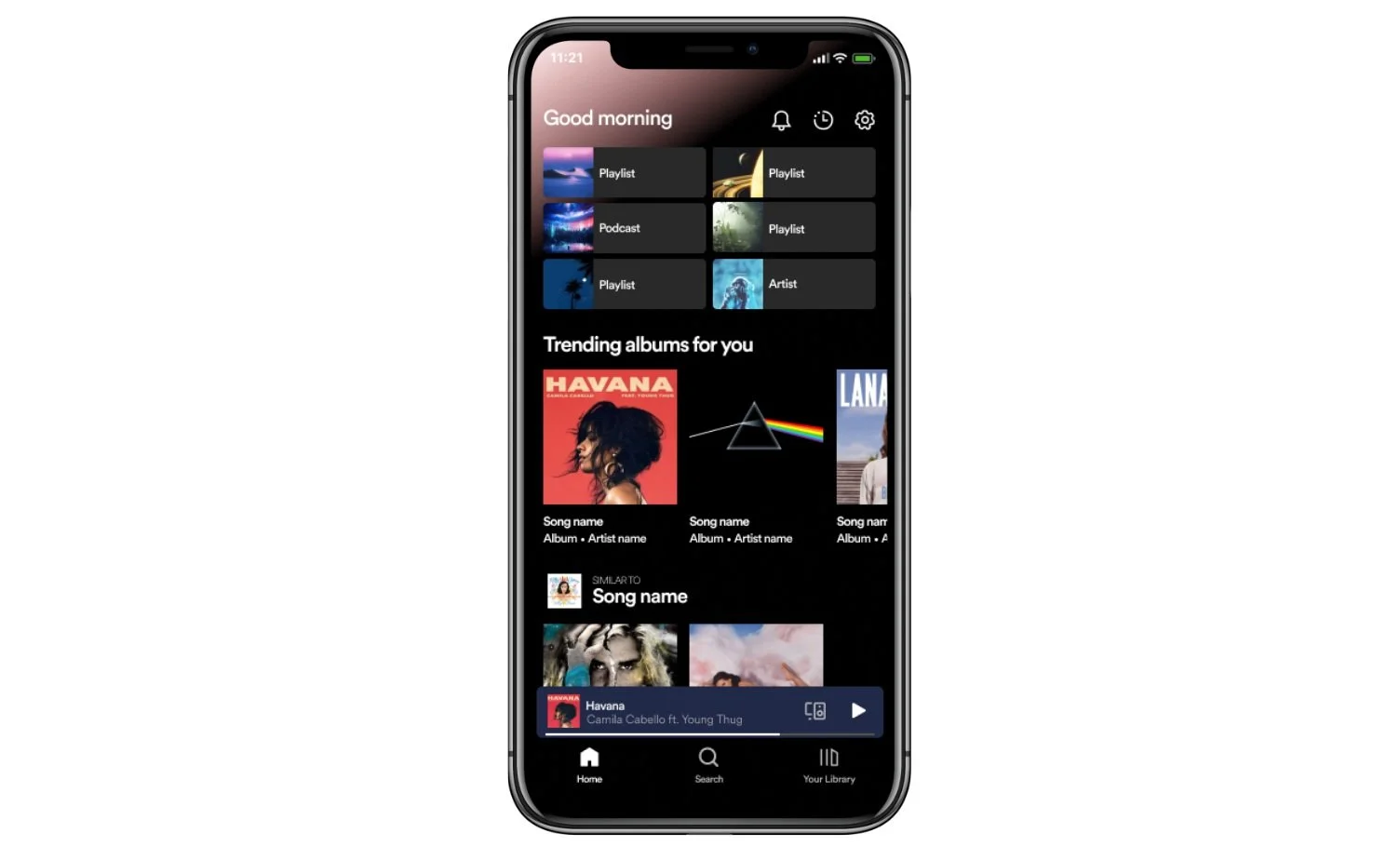
Overview:
Problem
Nowadays, there seems to be a disconnect between artists and listeners on this app. There really isn’t a way for artists and listeners to connect on the app. Also, of course artists want to promote their own songs, but there could be a way to show their listeners who else they listen to. Spotify wants to improve engagement and retention in the app.
Goals:
To improve engagement and retention in the app - wanting to expand on their social capabilities.
Understand the ins and outs of the app
To verify and understand what users really want out of the app
Understand what draws people to use Spotify versus other platforms
Design a new social feature that embeds within the current Spotify platform on iOS.
We want to understand the characteristics and needs of Spotify users so that we’re able to improve engagement and retention for the app.
Process Overview:
-
Identify the research goal, objectives, and questions.
-
Determine the best way of determining information architecture by feature roadmap, creating a site map, and creating page sketches.
-
Creating a task flow/user flow, responsive wireframes and wireframes in order to visualize the flow of the site.
-
Creation of a high fidelity prototype, conduct usability testing to ensure user flow, creating a flow map and affinity map.
Research
Research Plan, Interviews, Competitive Analysis, Persona, and Storyboard
Research plan:
In order to tackle this capstone, I created a research plan. First I created a research objective:
To verify and understand what users really want out of the app
Understand what draws people to use Spotify versus other platforms
Understand who my target audience is from my research
Next, I created research questions to find out what users wanted from Spotify. I wanted to make sure I thought of a feature that would be useful for people.
Who are the users for Spotify?
Who are the competitors for Spotify?
Why do people use music apps and what helps the apps’ retention?
Why do people use Spotify?
What are peoples’ pain points when using a music streaming app?
I then created questions to conduct an interview in order to answer the questions above.
Interviews:
I interviewed 4 people between the ages of 27 to 33 to answer the above questions and to ascertain what people want in a music app.
Results:
Three out of four participants use Spotify after using other apps.
One participant specifically stated she doesn’t care for the social media aspect for the app.
Main pain point for participants had something to do with playlists, whether it was difficulty in adding songs to specific playlists or the random songs that would slip into the playlists Spotify would generate.
In summary, it seems like participants of the interview only use Spotify to listen to music and don’t care for any integration of social media aspect to the app. With this in mind, I wanted to add a feature that people would actually use, instead of implementing something that would somewhat maybe benefit the business.
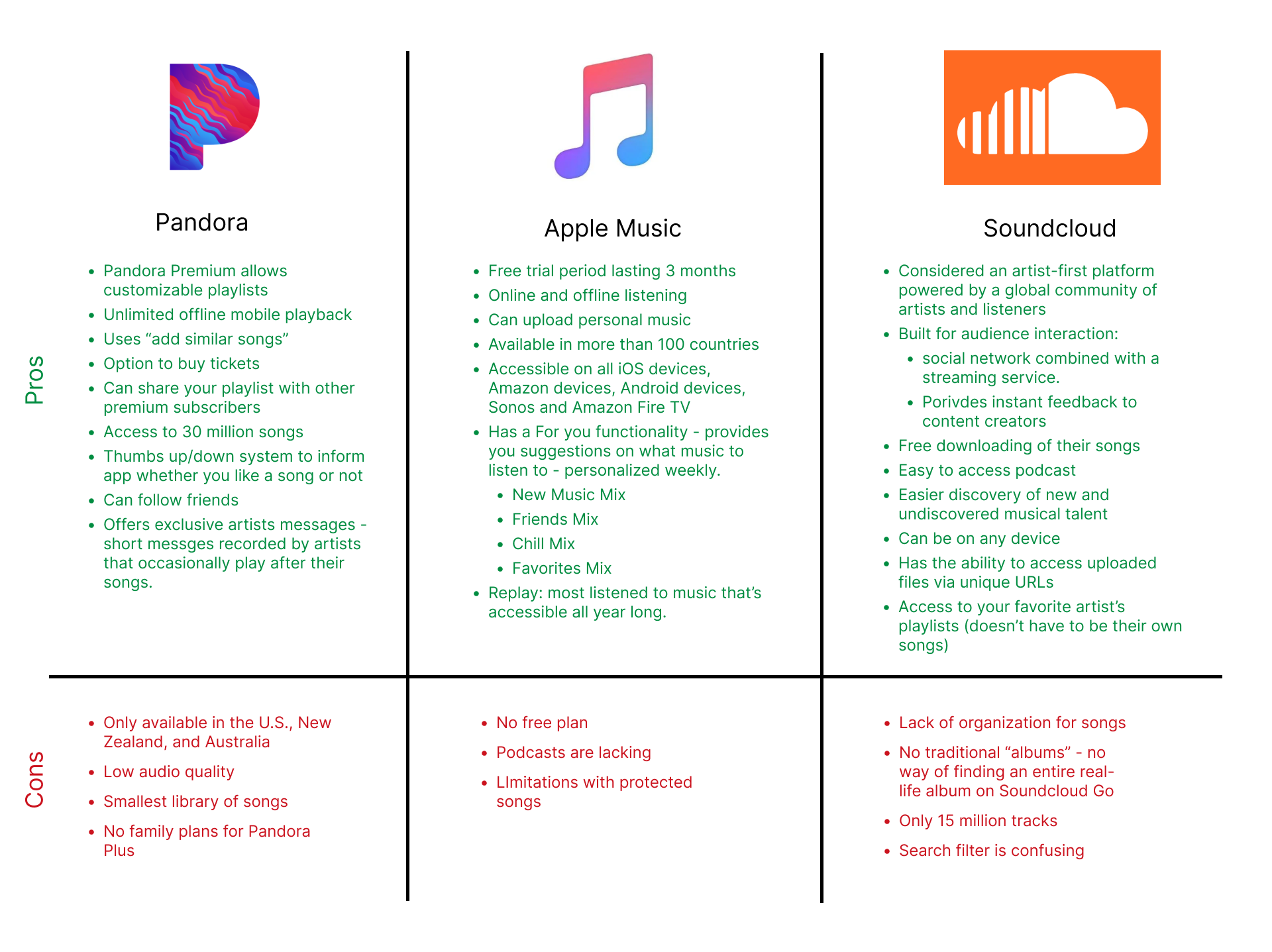
Competitive Analysis:
I researched three different music apps that are well known. Each app has its own list of pros and cons, which may or may not overlap with Spotify’s own pros and cons.
Persona:
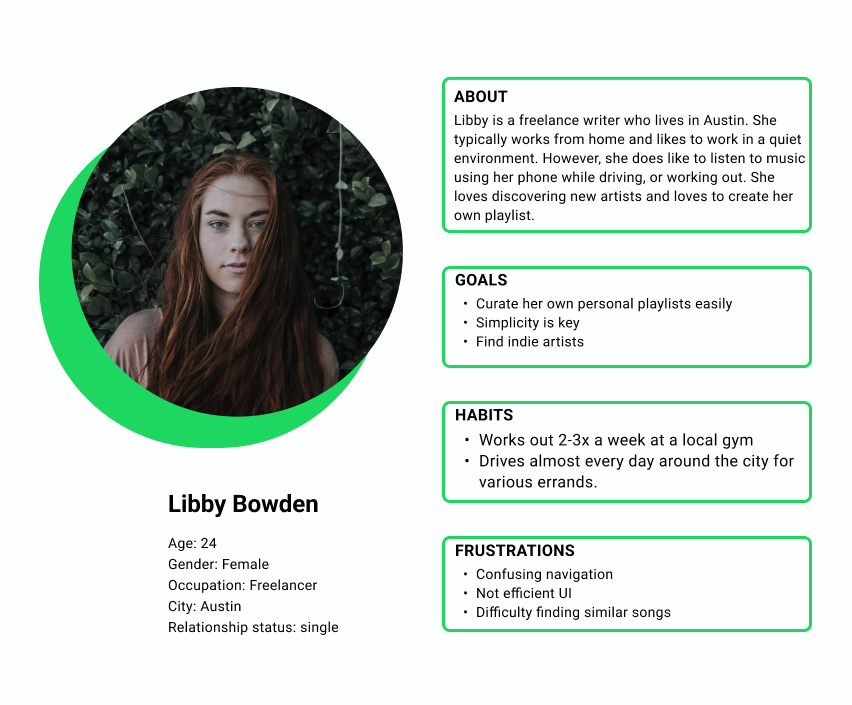
My persona is a culmination of the competitive analysis and user interviews. Meet Libby Bowden.
With my persona in mind, I created a storyboard of what my persona would do when trying to go through a scenario. The scenario I chose was my persona trying to find a similar song to the one she likes based on beat and similar melodies.
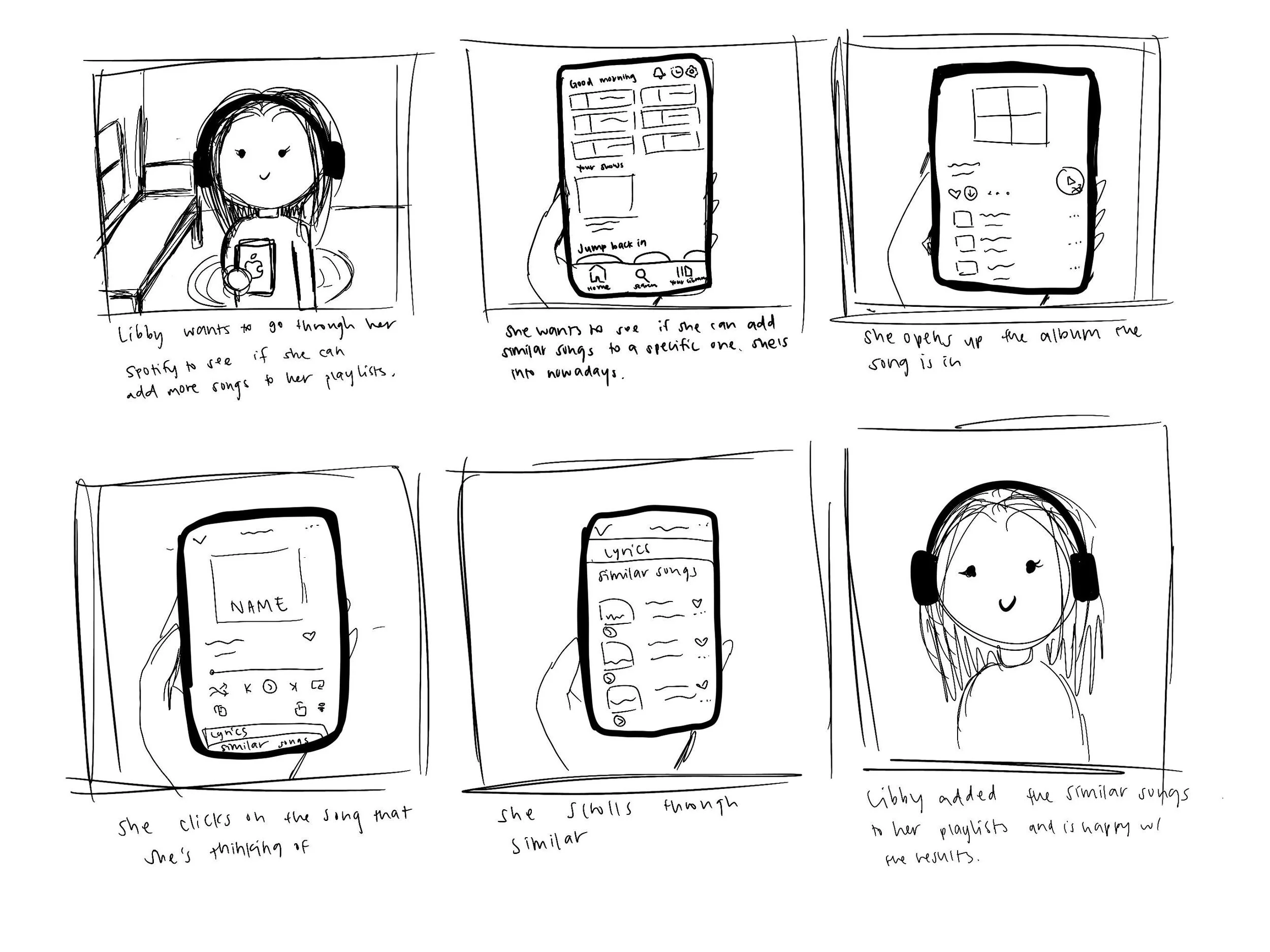
Storyboard
2. Information Architecture
Sketches and Sitemap
I created some sketches based off of what Spotify currently looks like, as well as the scenario above.
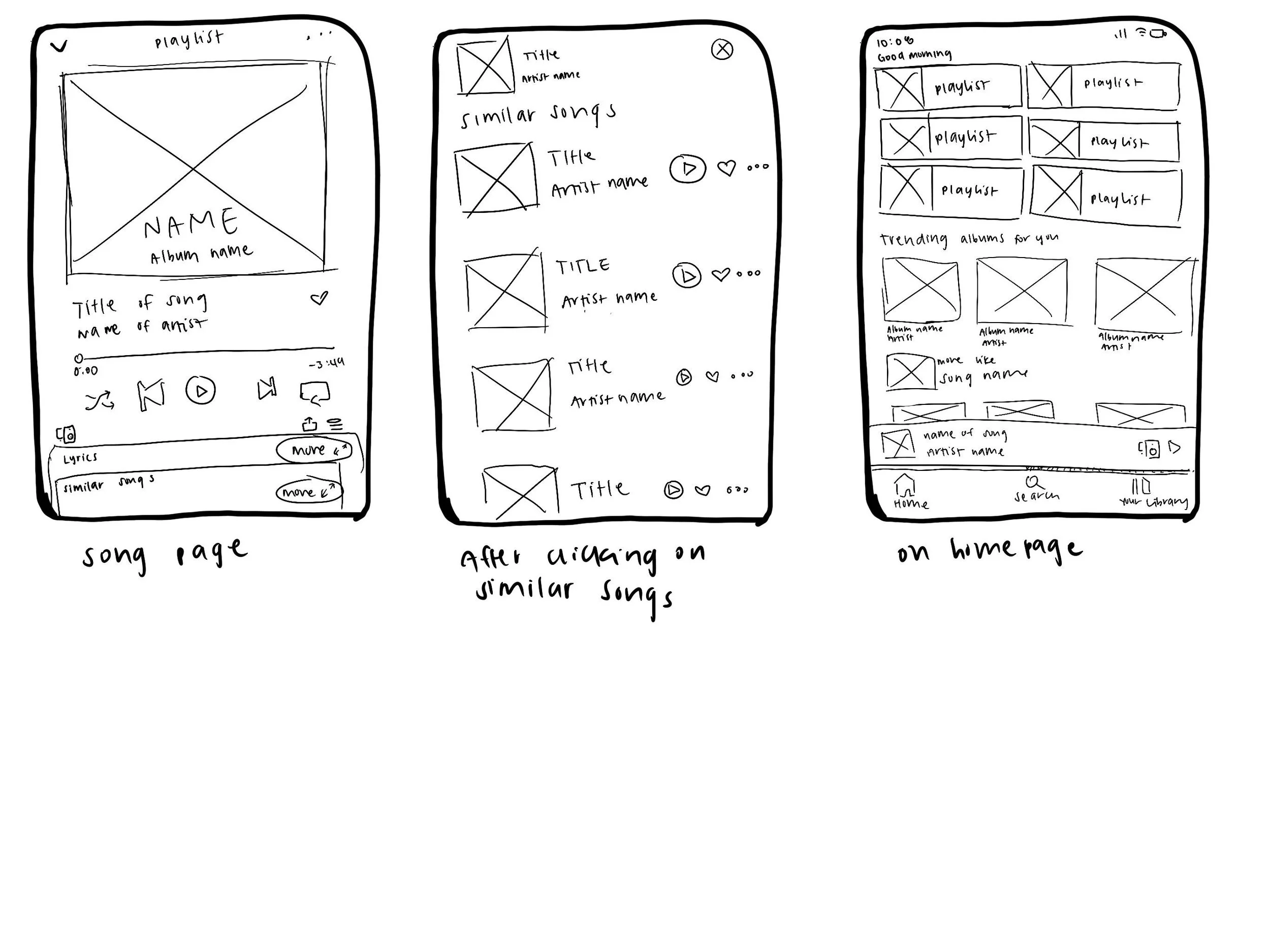
Sketches
I created a sitemap to lay out the different pages and items that would be on the pages. This was used later to create wireframes. At this point in time, I also thought of a feature where people would be allowed to upload their own music that wasn’t on Spotify, in order to integrate the idea of Soundcloud onto the system.
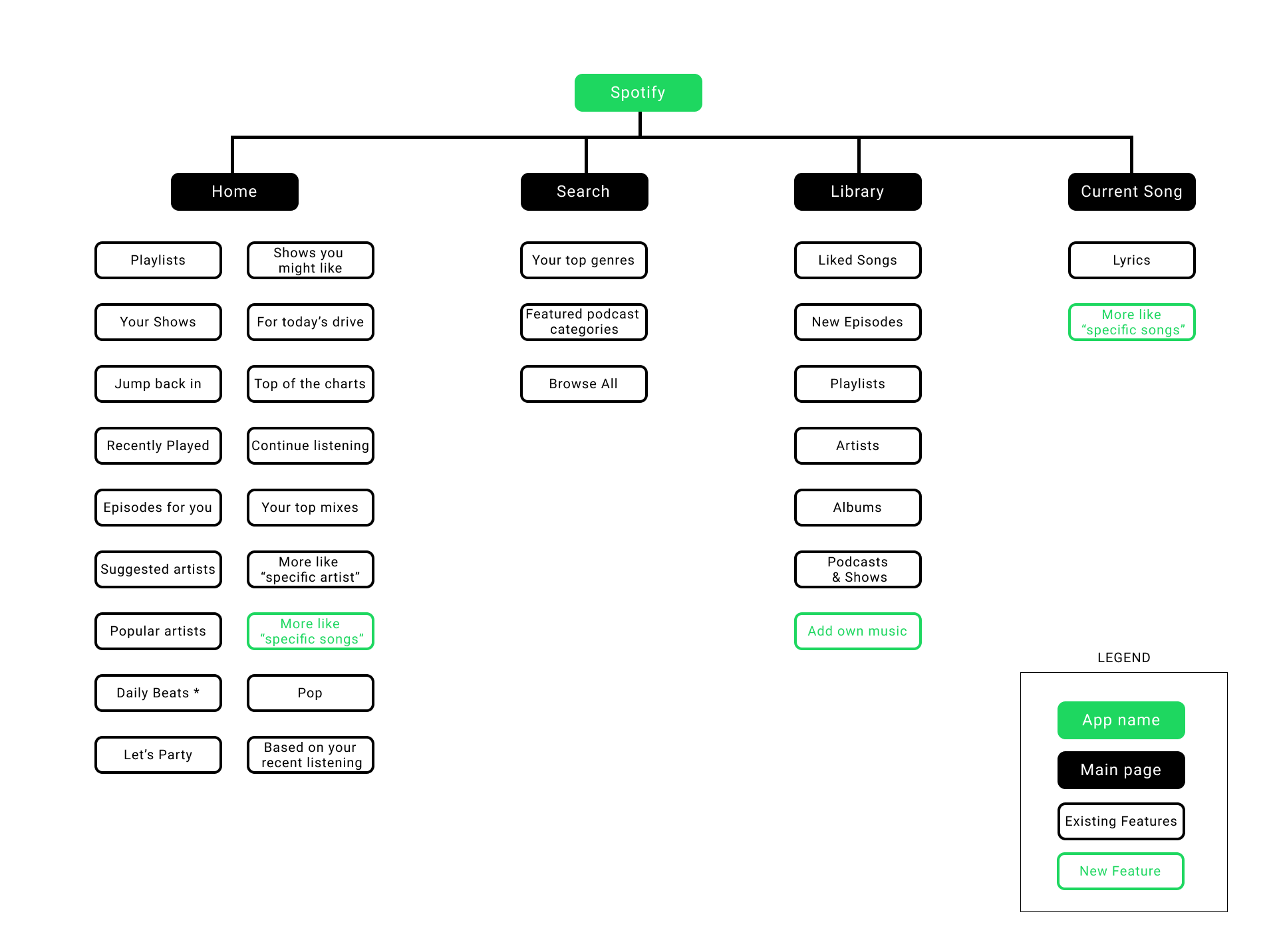
Sitemap
3. Interaction Design
Task Flow, User Flow, and Wireframes
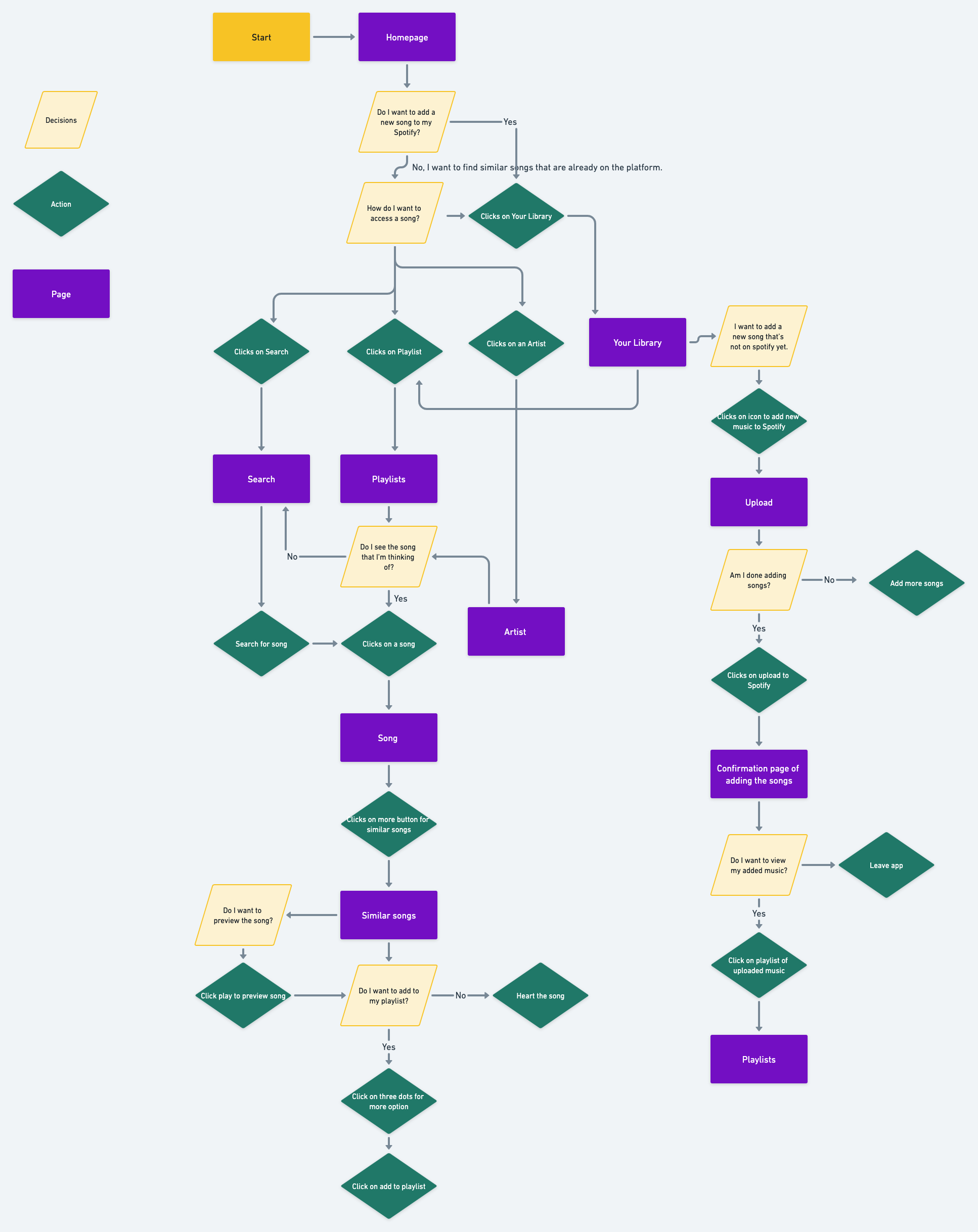
I created a task flow that my persona would take on this app. There are two tasks that the user could do - one being adding more songs to the app while the other is finding similar songs and adding them to one of her playlist.
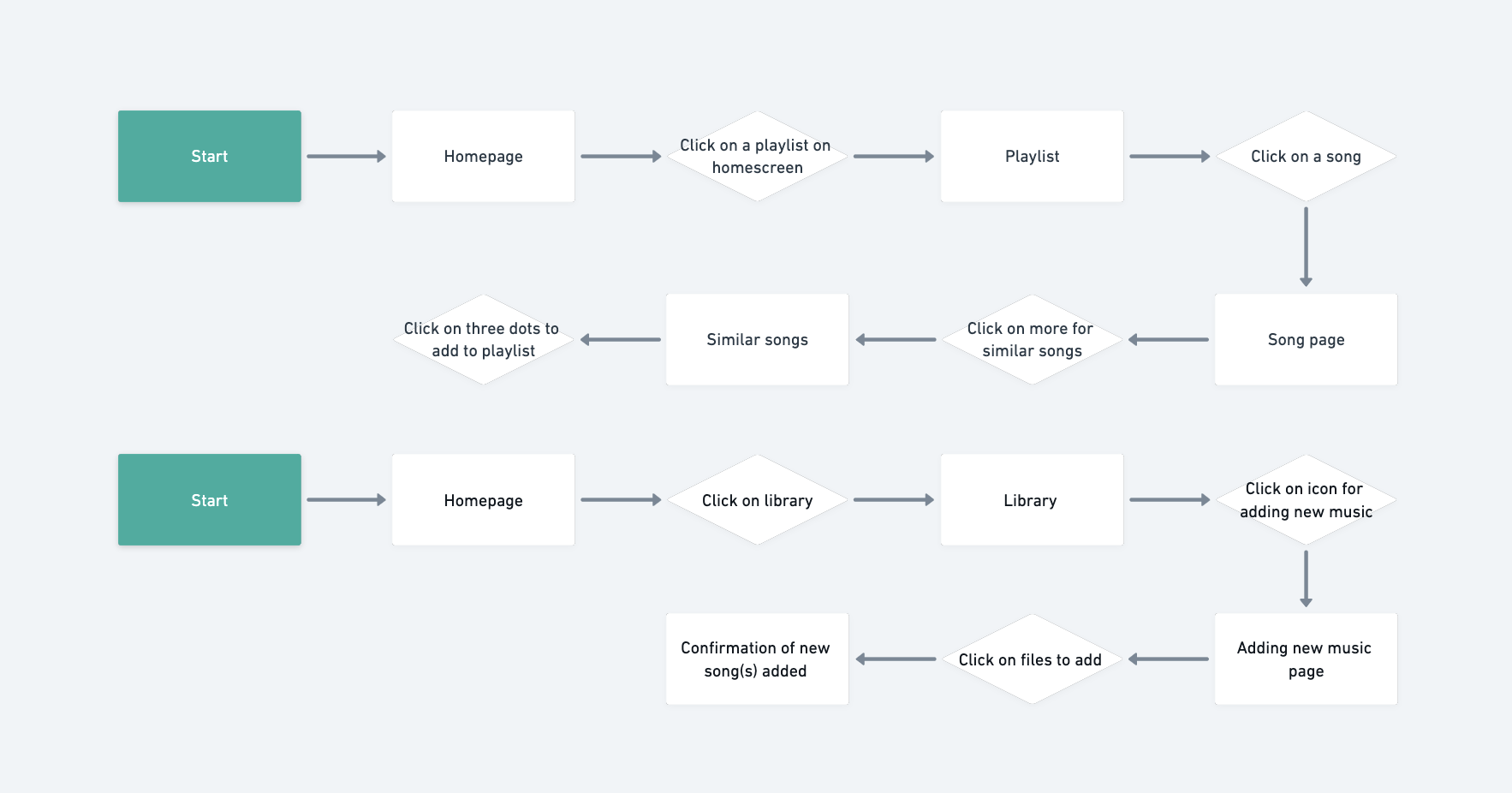
Task Flow
User Flow
I then created a user flow to map out the possible pathways that the persona could take. This is based off of the user task flow.
Product Requirements:
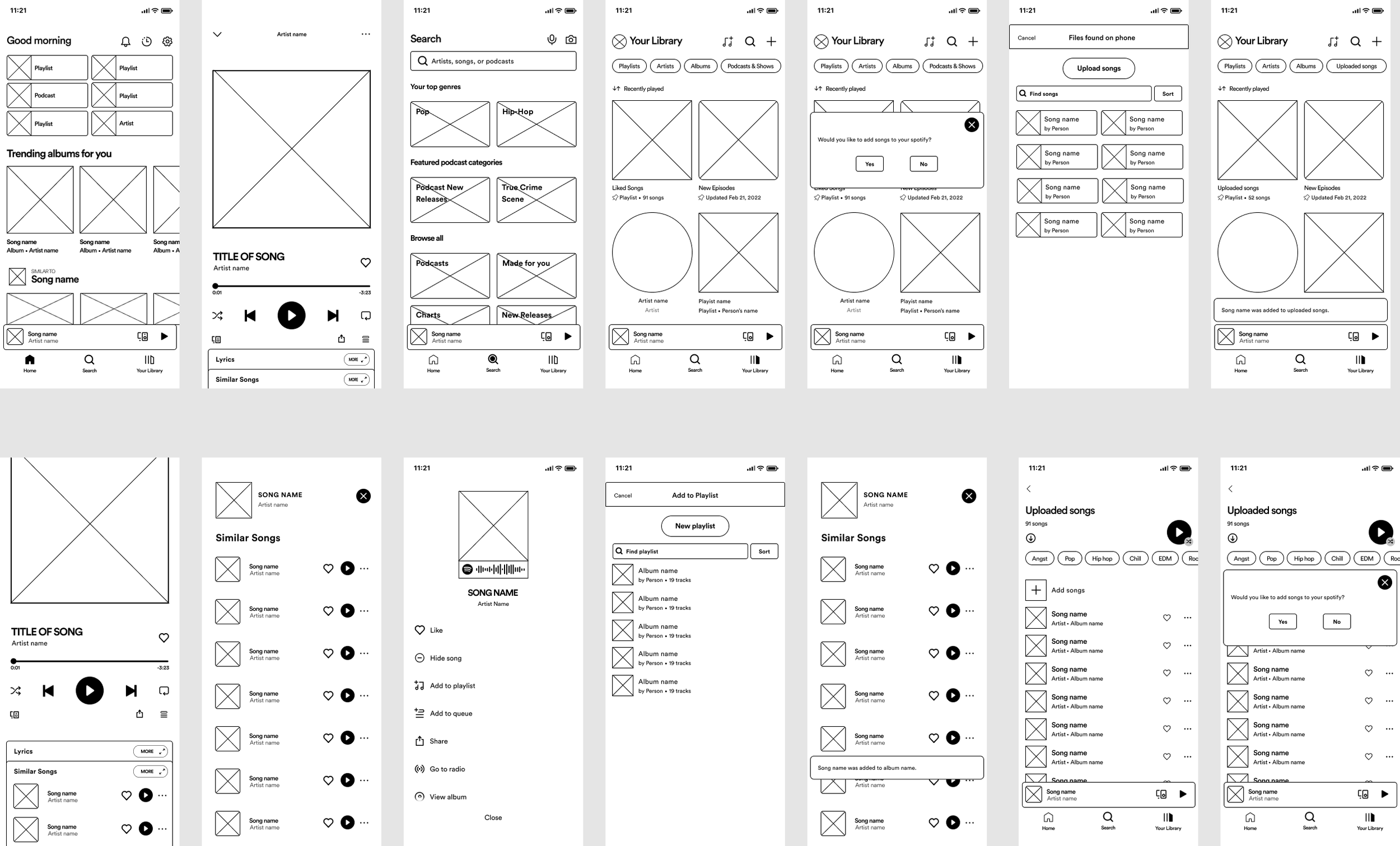
Product requirements was created based off of user flow, site map, and feature roadmap. I created a list of pages to design:
Homescreen
Song screen
Song screen that leads to similar songs screen
Similar songs list screen
Search screen
Library screen
Playlist screen
Uploaded song screen
I created a wireframe based off of the product requirements, user flow, and the sketches.
Wireframes
5. Iteration and Implementation
Prototype, Usability Testing, and Priority Revisions
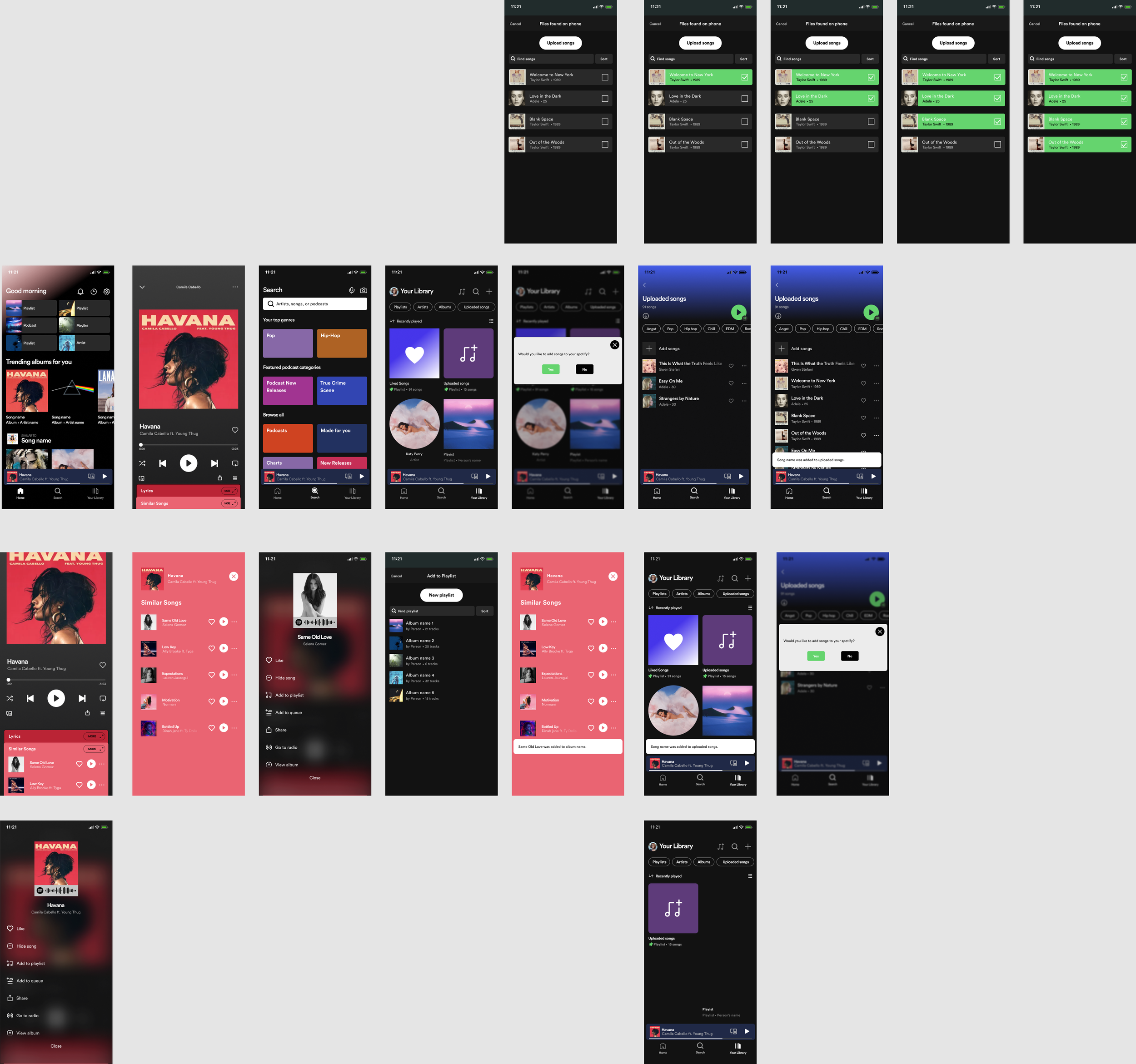
Since this is an already existing app, there was no need to create a moodboard or UI kit. I had taken a screenshot of the actual homescreen of my Spotify app in order to get the exact green shade Spotify was known for. I then filled in the rest of the pictures with either stock images or actual album images.
Prototype
I then created pathways on Figma, thinking of where potential users would click when trying to complete tasks.
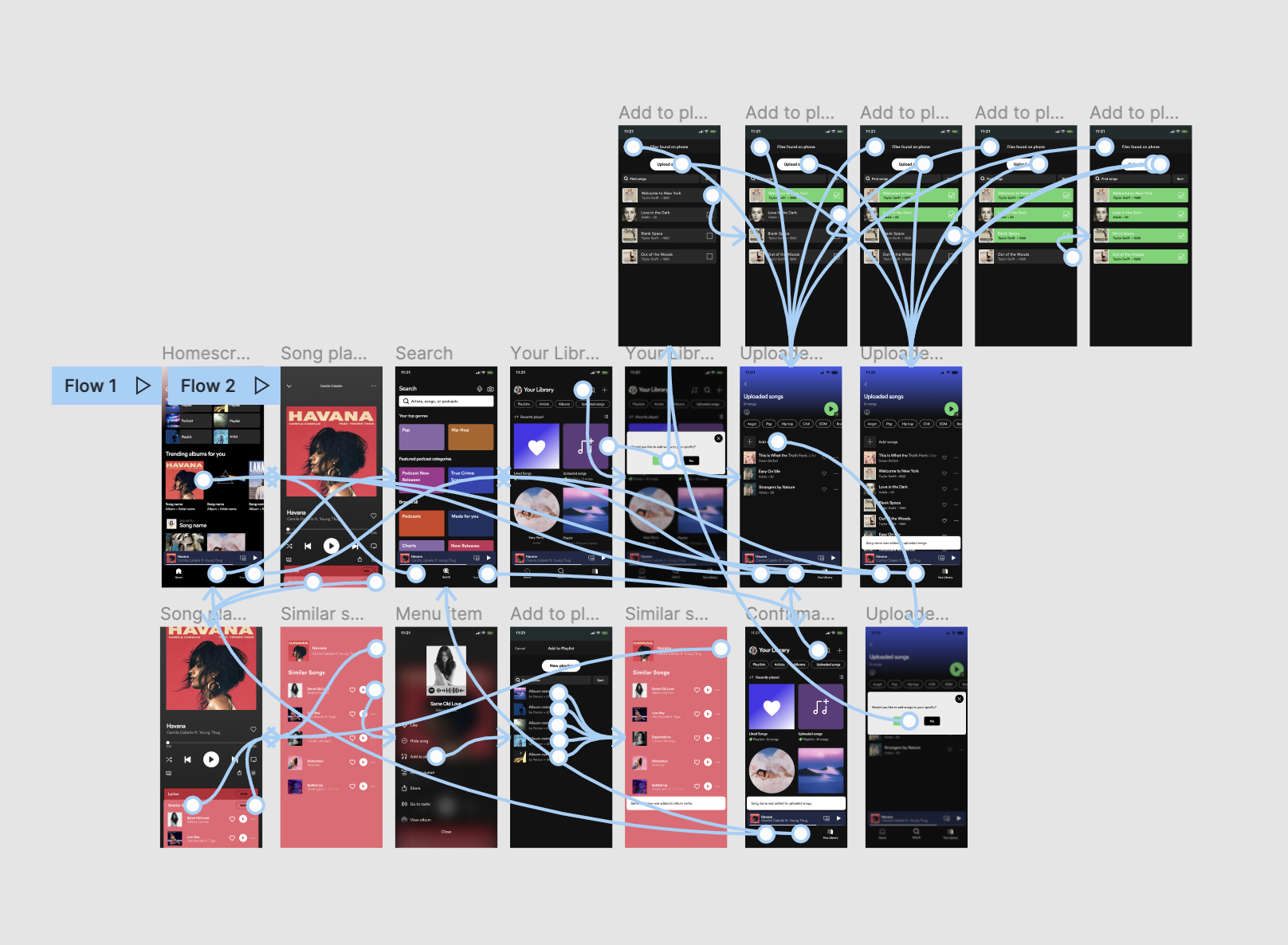
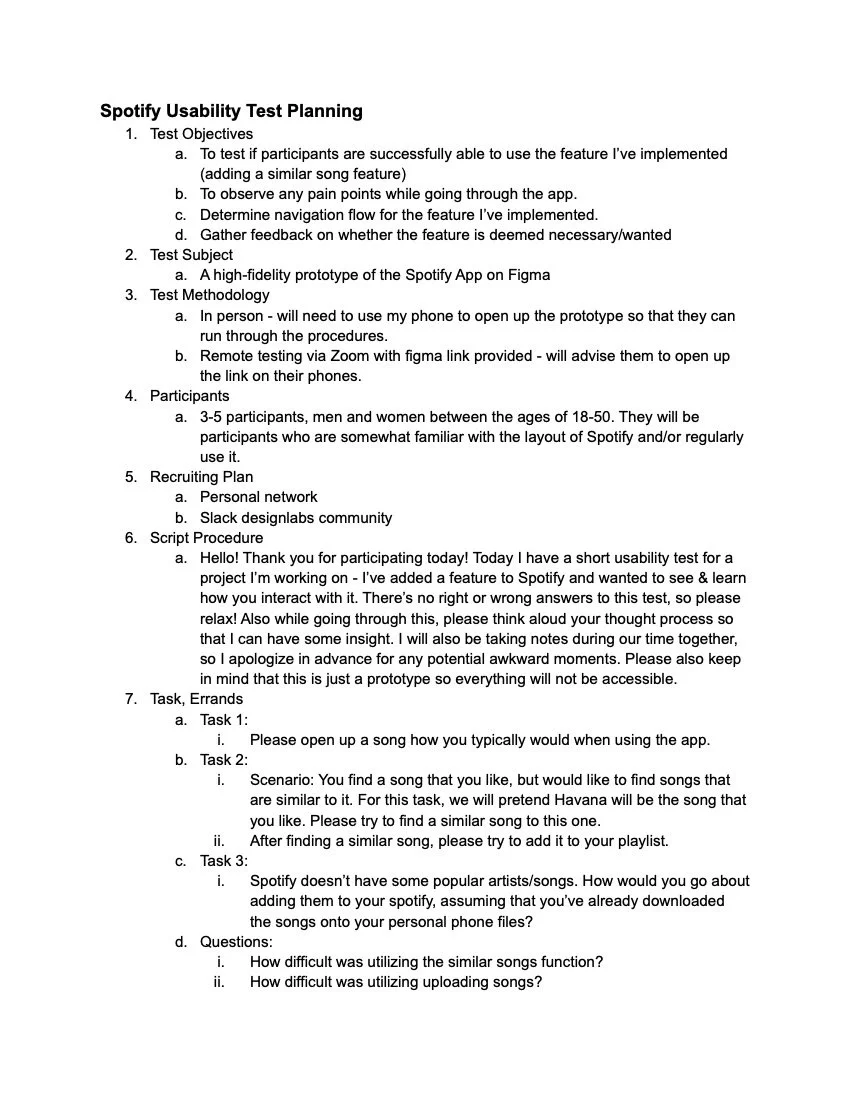
Usability testing was done in person. I asked four participants a series of questions and tasks to get data for an affinity map.
Test objectives:
To test if participants are successfully able to use the features implemented
To observe any pain points while going through the app
Determine navigation flow
Gather feedback on whether the feature is deemed necessary/wanted
Test goals:
To identify if the feature will be utilized and if it is easily accessible. To also identify possible pain points that would need improvements, and to see if tasks are easily completable.
Usability Testing
Testing results:
Participant one & two are very familiar with Spotify while three is not so familiar with it. Participant one listens to songs by finding them via search bar while participant two clicks on his playlist. Participant three just listens to playlists that Spotify creates, i.e., daily mixes.
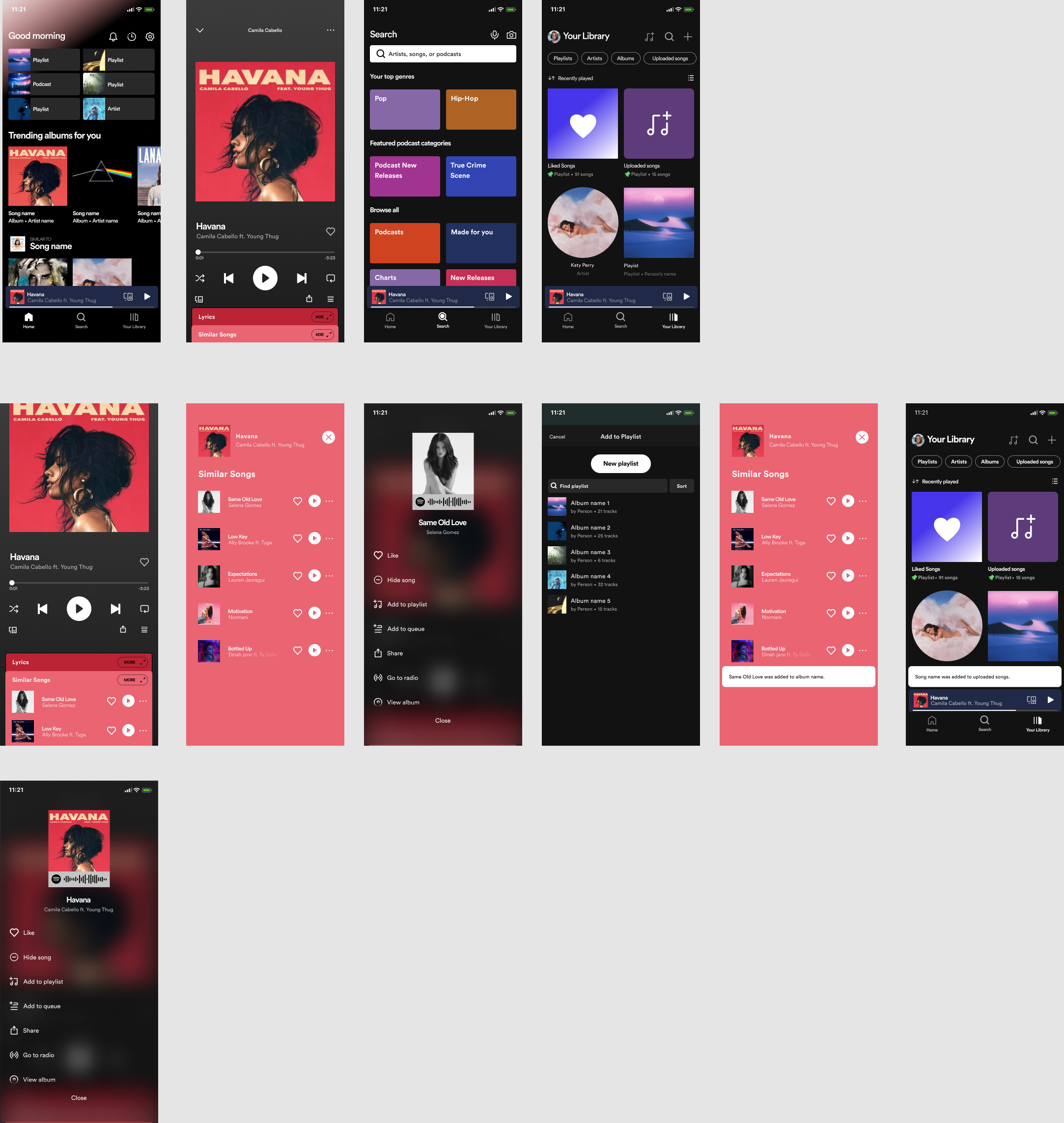
All three participants were able to successfully use the feature where there's similar songs
Two out of three were able to successfully upload songs onto their Spotify under the assumption that their phone already contained downloaded songs. These two were also able to do so with 0% error rate.
While all three participants agreed that the similar songs function was useful, they all stated that they could not see themselves uploading songs on their own.
The link to view the Figma file can be found at the top of the page. I took away the feature to add songs since it wasn’t something that the users were interested in using.
Priority Revisions
Final thoughts:
After finishing the revision, if I had more time I'd do a second round of interview questions in order to see if there's anything else to add to this project since the feature I added was somewhat minor.